

Data Science AI Skills Showdown: Which Agent Handles Your Data Best?
Published by BytesAgain · May 2026
Every data scientist knows the feeling: you have a raw dataset, a tight deadline, and a growing list of questions. You need an AI agent that can clean the noise, spot the outliers, build a quick model, and present findings — all without constant hand-holding. That's exactly what the Data Science AI use case on BytesAgain delivers. It's designed to automate the repetitive parts of exploratory analysis, model prototyping, visualization, and report generation.
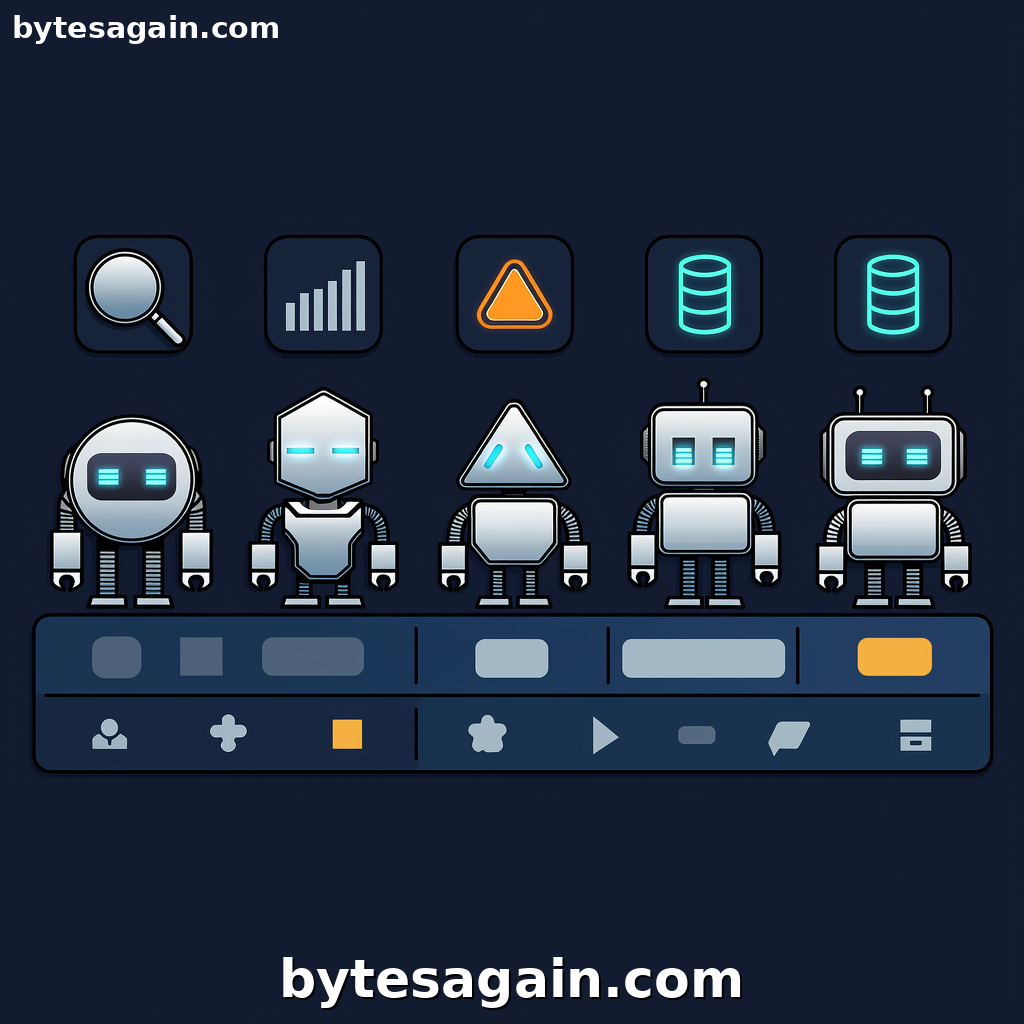
But with five distinct skills available — from general-purpose data analysis to specialized database design — how do you choose the right agent for your task? Each skill brings a unique strength to the table. This comparison breaks down exactly what each one does, where it excels, and when you should pick one over the others.
The Five Skills at a Glance
1. Data Analysis
This is your go-to for general-purpose data work. It queries databases, generates reports, automates spreadsheets, and turns raw numbers into actionable insights. If you need a quick summary of a CSV or a bar chart for a presentation, this skill handles it. Its strength is breadth — it covers visualization, database queries, and report generation in one package.
2. Data Analyst
Think of this as a more task-oriented version of Data Analysis. It's built to complete specific data analysis tasks you delegate, especially when those tasks involve file operations. It expects you to list files in the upload parameters and then executes your instructions. This skill is ideal for users who know exactly what they want done and need a reliable executor.
3. Data Anomaly Detector
This skill specializes in one thing: finding what's wrong. It detects anomalies and outliers in construction data — unusual costs, schedule variances, and productivity spikes. It uses both statistical and machine learning methods. If your work involves project budgets, timelines, or resource allocation, this skill saves hours of manual inspection.
4. Data Cog
Powered by CellCog, this skill offers a full pipeline: data cleaning, exploratory analysis, hypothesis testing, statistical reports, and ML model evaluation. It's the most comprehensive of the five, covering everything from raw data to model insights. If you're prototyping a machine learning model and need to validate assumptions, Data Cog is your best bet.
5. Database Design
Written primarily in Chinese (with English support), this skill focuses on the structural side of data. It handles table design, normalization, indexing strategies, migration scripts, test data generation, and ER diagram descriptions. It's for data engineers and architects who need to build or refactor databases, not analyze existing data.
Side-by-Side Comparison
Core Focus
Data Analysis and Data Analyst both target general data tasks, but Data Analysis leans toward insight generation while Data Analyst emphasizes task execution. Data Anomaly Detector is narrowly focused on outlier detection in construction. Data Cog is the most research-oriented, covering the full ML pipeline. Database Design is purely structural.
Best For
- Quick reports and visualizations: Data Analysis
- File-based task execution: Data Analyst
- Construction project oversight: Data Anomaly Detector
- Model prototyping and hypothesis testing: Data Cog
- Schema design and database architecture: Database Design
Skill Depth
Data Analysis and Data Analyst are broad but shallow — they handle many tasks at a basic level. Data Cog goes deep into statistics and ML evaluation. Data Anomaly Detector is deep within its niche. Database Design is deep in database theory and practice.
Language Support
Database Design is primarily Chinese with English capabilities. The other four are English-first.
When to Avoid
- Avoid Data Analysis if you need specialized anomaly detection or database design.
- Avoid Data Analyst if your task isn't file-based or clearly defined.
- Avoid Data Anomaly Detector for non-construction datasets.
- Avoid Data Cog for simple spreadsheet automation — it's overkill.
- Avoid Database Design if you're analyzing existing data rather than building new structures.
Real-World Scenario: A Construction Project Analysis
Let's say you're a project manager at a mid-sized construction firm. You have a spreadsheet with 10,000 rows tracking costs, schedules, and productivity across three active sites. You need to:
- Clean the data (remove duplicates, fix date formats)
- Identify any cost overruns or schedule delays
- Build a simple model to predict which projects might go over budget
- Present findings to stakeholders in a report with charts
Here's how the skills stack up:
Start with Data Cog. Its cleaning and exploratory analysis features handle the messy spreadsheet. Run hypothesis tests to check if cost variances are random or systematic. Then use its ML model evaluation to prototype a budget overrun predictor.
Next, bring in Data Anomaly Detector to spot specific outliers — a supplier charge that's three standard deviations above average, or a week where productivity dropped 40%. Its construction-specific methods catch patterns a general tool might miss.
For the final report, use Data Analysis to generate clean visualizations and a summary document. It automates the chart creation and report formatting, saving you hours of manual work.
What about the others? Data Analyst could replace Data Analysis if you have specific file operations in mind. Database Design is irrelevant here — you're not building a new database, just analyzing existing data.
Actionable advice: For complex data science workflows, combine a broad skill like Data Cog with a specialized skill like Data Anomaly Detector. The broad skill handles the pipeline; the specialized skill catches what the generalist misses.
Which Skill Should You Choose?
For the solo data scientist or analyst
Start with Data Analysis. It covers 80% of your daily tasks: querying databases, generating reports, and creating visualizations. When you need to prototype a model, switch to Data Cog for its statistical rigor and ML evaluation.
For the construction project manager or controller
Data Anomaly Detector is your primary tool. It's built for your industry's data quirks. Pair it with Data Analysis for report generation.
For the data engineer or database architect
Database Design is essential for schema work. You'll rarely need the analysis-focused skills unless you're also doing data science.
For the manager delegating tasks to an AI agent
Data Analyst is your executor. Give it clear instructions and files, and it delivers. Use Data Analysis when you need insights rather than task completion.
For the ML researcher or student
Data Cog is your best match. It covers the full modeling workflow from cleaning to evaluation. Supplement with Data Analysis for polished visualizations.
Final Takeaway
No single skill covers every data science need. The Data Science AI use case on BytesAgain gives you a toolkit, not a single tool. For maximum efficiency, combine a broad skill like Data Analysis or Data Cog with a specialized skill like Data Anomaly Detector or Database Design. Match the skill to your specific task — not just to your job title.
Find more AI agent skills at BytesAgain.