

Published by BytesAgain · May 2026
DevOps Automation Hub: Which AI Skill Unlocks Your Pipeline?
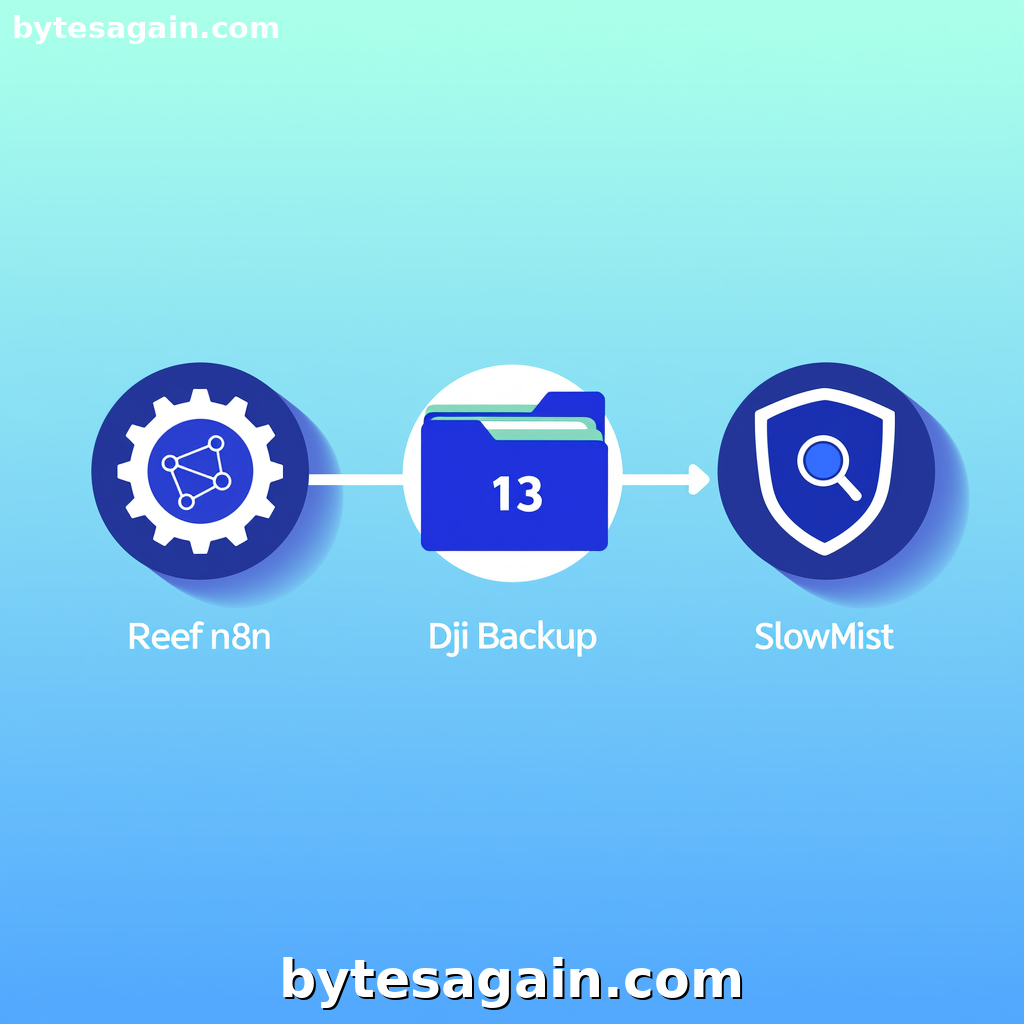
Every engineering team wants a single, reliable workflow that connects code commits to production deployments—without manual handoffs, configuration drift, or security surprises. The DevOps Automation Hub at BytesAgain addresses this by combining three specialized AI agent skills: workflow orchestration, artifact backup, and pipeline security validation. But which skill should you prioritize for your team? This comparison breaks down reef-n8n-automation, dji-backup, and slowmist-agent-security to help you decide which AI agent skill fits your specific DevOps scenario.
What Each Skill Brings to the Table
Reef n8n Automation (reef-n8n-automation) is the workflow engine of the trio. It lets you build, customize, and deploy n8n workflows using a library of over 2,000 templates. Think triggers from GitHub pull requests, actions for build servers, error-handling branches, and multi-step automation that connects tools like Slack, Docker, and cloud APIs. This skill is for teams that want to automate event chains without writing glue code.
Dji Backup (dji-backup) focuses on one thing: reliable, versioned backups. Originally designed for camera footage, its core mechanism—copying files from a source to a numbered backup folder on a NAS—translates directly to DevOps. Use it to archive build artifacts, container images, or log files before each deployment, ensuring you always have a recoverable snapshot.
SlowMist Agent Security (slowmist-agent-security) acts as your pre-deployment auditor. It reviews skill installations, MCP plugins, GitHub repositories, URLs, and on-chain addresses for supply-chain risks. Before you run that new GitHub Action or install a community plugin, this skill validates the component against known vulnerabilities and suspicious patterns.
Side-by-Side: When to Use Each Skill
These three skills are complementary, not competitive. Each solves a distinct pain point in the DevOps lifecycle.
Workflow Automation: reef-n8n-automation
This is your starting point if you lack a unified event system. Instead of manually triggering builds after a PR merge or copying logs between services, an n8n workflow handles the chain automatically.
Best fit for: Teams with multiple SaaS tools that don't talk to each other. You want a GitHub push to trigger a build, then a test run, then a Slack notification—all in one visual workflow.
What it does best: Connecting disparate services through a template library. You don't need to write API integrations from scratch. The skill handles authentication, retries, and error routing.
Limitation: It orchestrates events but doesn't validate security or preserve artifacts. You'll want companion skills for those tasks.
Artifact Archival: dji-backup
DevOps generates ephemeral artifacts—build outputs, logs, configuration snapshots—that teams often lose when pipelines overwrite them. Dji Backup solves this by creating numbered, versioned backups on a NAS.
Best fit for: Teams that need to roll back deployments or audit historical builds. If your CI/CD pipeline doesn't preserve previous artifacts, this skill fills the gap.
What it does best: Simple, deterministic backup with no complex configuration. Each run creates a new numbered folder, so you always know where to find version N of your artifact.
Limitation: It's a backup tool, not a workflow orchestrator. It won't trigger builds or validate plugins. Use it as a final step in an n8n workflow.
Pipeline Security: slowmist-agent-security
Supply-chain attacks are a growing threat. This skill checks every component before it enters your pipeline—from GitHub Actions to MCP plugins to third-party URLs.
Best fit for: Security-conscious teams or those using community-sourced integrations. If you install plugins from public repositories, you need pre-deployment validation.
What it does best: Comprehensive reviews that cover skill/MCP installation, GitHub repo analysis, and on-chain address checks. It flags suspicious patterns before they reach production.
Limitation: It doesn't automate workflows or create backups. It's a gate, not a runner.
Real-World Example: Deploying a Microservice
Imagine your team is deploying a Node.js microservice. Here's how these skills work together:
- A developer merges a PR on GitHub. The reef-n8n-automation skill detects the event and triggers a build on your CI server.
- Before the build runs, slowmist-agent-security validates the new GitHub Action used in the workflow. It checks the action's repository for known vulnerabilities and flags any suspicious dependencies.
- The build completes. dji-backup copies the build artifact (a Docker image or ZIP file) to your NAS under a new numbered folder:
/backups/build-042. - The n8n workflow sends a Slack notification with the build status and backup location.
In this flow, each skill handles one phase. Without n8n, you'd manually trigger the build. Without SlowMist, you'd risk a compromised action. Without Dji Backup, you'd lose the artifact on the next build.
Actionable advice: Start with the skill that addresses your biggest bottleneck. If you have no automation, begin with
reef-n8n-automation. If you've been burned by a supply-chain attack, prioritizeslowmist-agent-security. If you need historical artifact recovery,dji-backupis your first step.
Recommendation: Which Skill for Which User?
For the Solo Developer or Small Team
Start with reef-n8n-automation. Your immediate need is reducing manual steps. The template library lets you set up a basic CI/CD chain in minutes. Once that's stable, add dji-backup to preserve build outputs.
For the Platform Engineering Team
You likely already have automation. Focus on slowmist-agent-security to harden your pipeline against third-party risks. Use reef-n8n-automation to extend your existing toolchain with custom workflows.
For the Security-First Organization
Lead with slowmist-agent-security as your gatekeeper. Then layer reef-n8n-automation for orchestration and dji-backup for compliance-grade artifact retention.
For Teams Running High-Risk Deployments
Use all three. The combination creates a closed loop: trigger → validate → build → backup → notify. No manual handoffs, no security gaps, no lost artifacts.
Final Take
The DevOps Automation Hub at BytesAgain isn't about choosing one skill over another. It's about recognizing that modern pipeline management requires three distinct capabilities: orchestration, preservation, and validation. Start where your pain is greatest, then expand.
Explore the DevOps use case to see how these skills integrate with your existing tools.
Find more AI agent skills at BytesAgain.