

AI Agent Skills for Research Summary Generator AI: Your 2026 Guide to Mastering Literature Reviews
In 2026, the landscape of academic research has been transformed. Gone are the days when a literature review meant weeks of slogging through PDFs, manually cross-referencing citations, and wrestling with imposter syndrome. According to the UK’s 2026 Higher Education Policy Institute survey, generative AI is now nearly ubiquitous among university students—but the experience is wildly uneven. Many still struggle with “reading fatigue,” AI hallucinated citations, and output that lacks academic rigor.
Enter the Research Summary Generator AI: an agent-powered system that doesn’t just summarize papers but orchestrates multi-source research, verifies citations, and produces structured, publishable reviews. The key to unlocking its full potential lies in specialized AI agent skills—modular capabilities that handle everything from secure networking to deep-dive subtopic exploration. Below, we explore five essential skills from the BytesAgain ecosystem that power next-generation research summarization.
Why Research Summary Generator AI Matters in 2026
The problem is clear: traditional literature reviews are a bottleneck. A 2026 study by Microsoft Research notes that AI has evolved from a “gentle guide” to a “collaborative reasoning partner.” Yet, without proper scaffolding, even the best LLM will fabricate references or miss critical connections. The solution is a skill-based agent architecture that combines:
- Secure, verifiable data handling (no more “trust me, bro” citations)
- Multi-channel research (academic papers, code repositories, discussion forums)
- Iterative refinement (drill down into subtopics without losing context)
- Unified reporting (merge multiple review types into one coherent document)
The following skills, available on BytesAgain.com, are designed to turn your AI into a rigorous, efficient research assistant.
Trends from Web Research
- Citation credibility crisis: Tools like 维普科创助手 (VIP Sci-Tech Assistant) now offer 10 billion+ verifiable Chinese academic resources, with every output clickable for source validation.
- Speed vs. depth: The best tools (e.g., those reviewed on 什么值得买) balance rapid summarization with the ability to trace claims back to original papers.
- Student adoption gap: The UK HEPI survey reveals that while 80% of students use AI, only 30% feel confident in its academic integrity—highlighting the need for skills that enforce accuracy.
Essential AI Agent Skills for Research Summary Generation
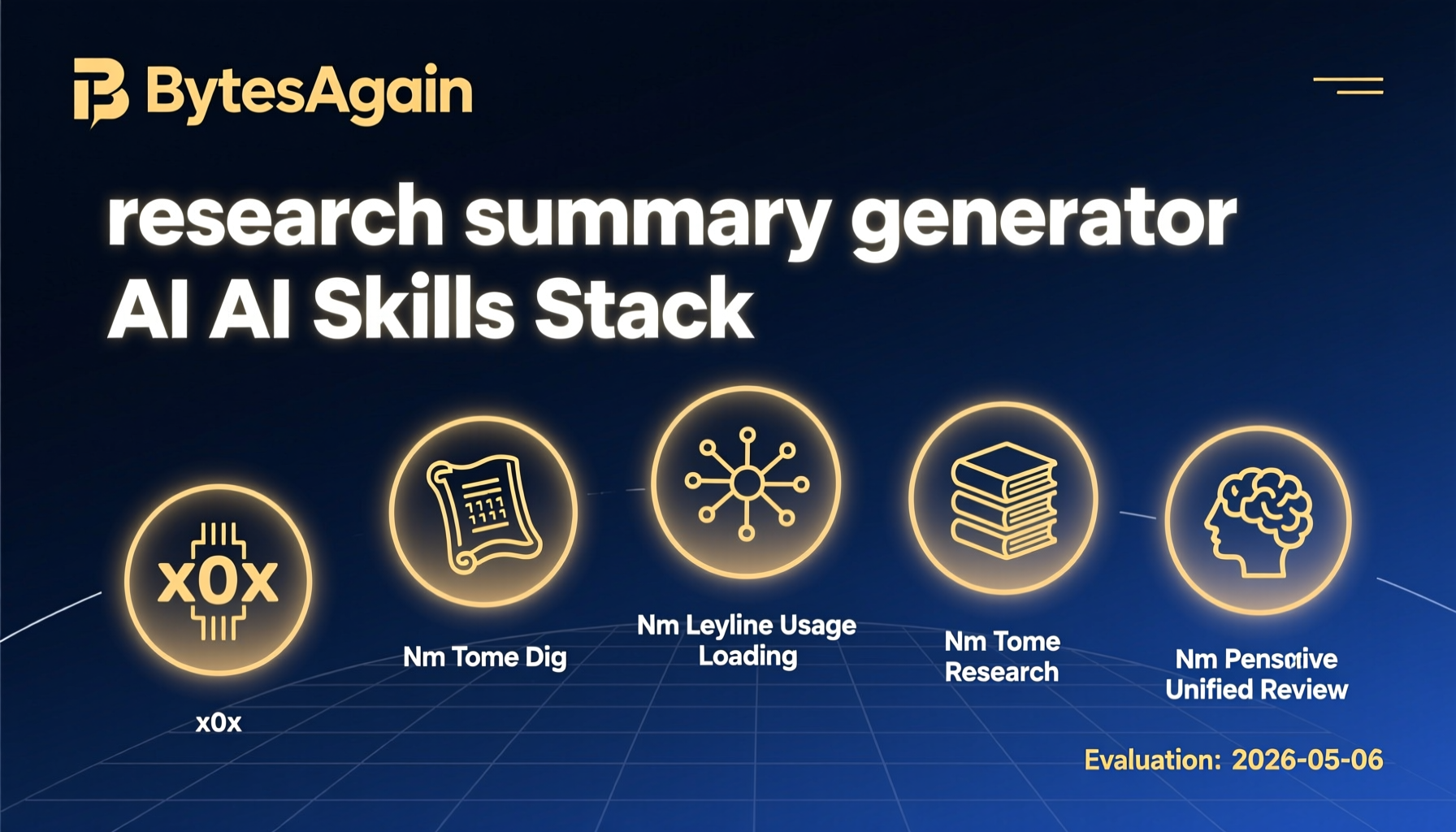
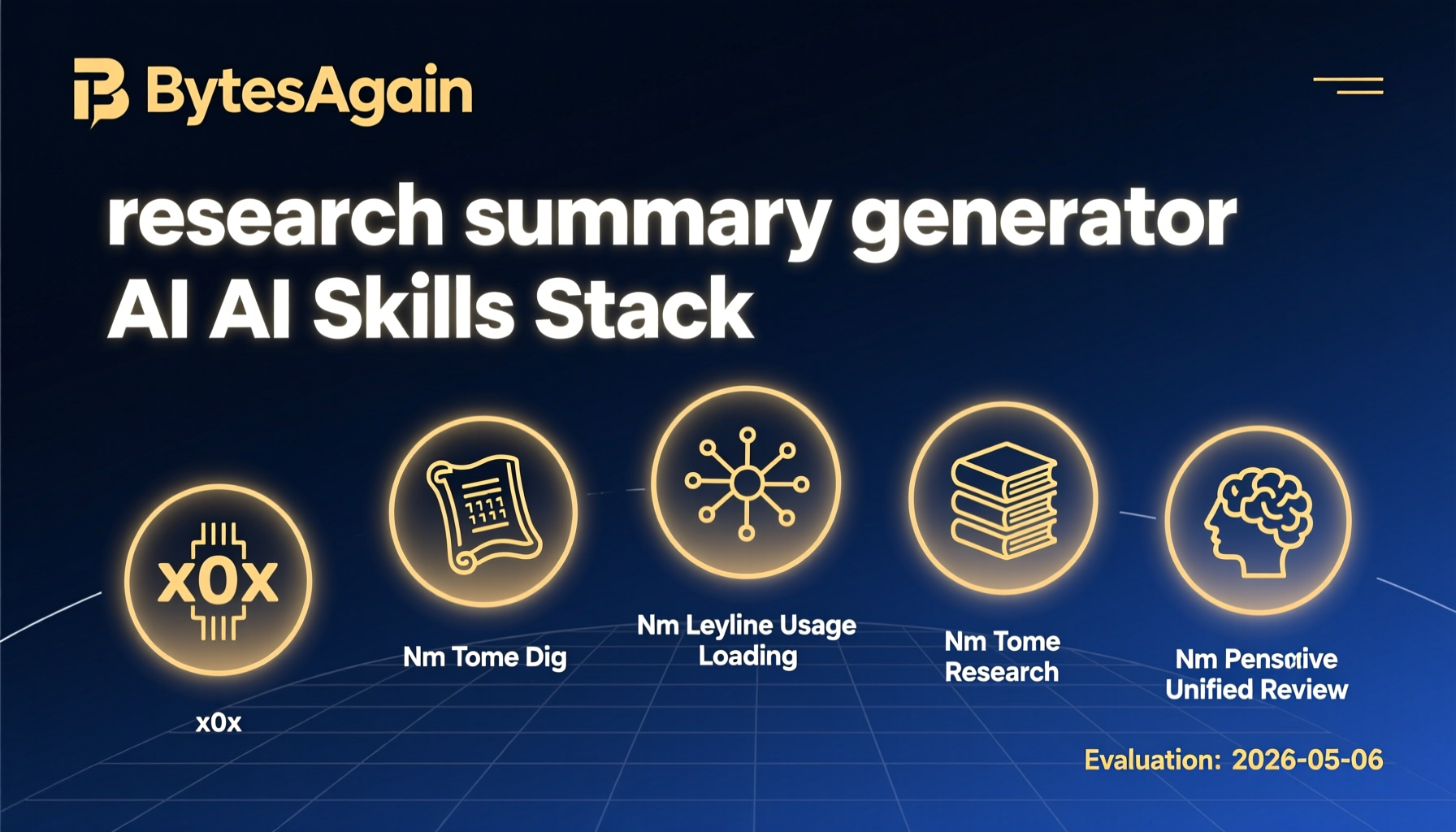
1. x0x — Secure Computer-to-Computer Networking
Key Features: Post-quantum encrypted gossip broadcast, direct messaging, CRDTs (Conflict-Free Replicated Data Types), and NAT traversal. This skill enables multiple AI agents—or your agent and external research databases—to communicate securely without a central server.
Setup: Integrate via the BytesAgain CLI or API. Requires a public key pair for encryption. No cloud dependency; works peer-to-peer.
Results: In a research summary workflow, x0x allows your agent to securely fetch papers from distributed repositories (e.g., institutional archives, arXiv mirrors) without exposing your query history. It also enables collaborative reviews where multiple agents share findings without data leaks.
2. Nm Tome Dig — Interactive Sub-Topic Refinement
Key Features: Loads the active research session and merges new findings into it. You can “dig” into a specific subtopic (e.g., “battery degradation in EVs”) and the skill automatically updates the existing summary with new citations and connections.
Setup: Install via BytesAgain package manager. Requires a running research session (e.g., from Nm Tome Research). Use a simple command: dig "solid-state battery electrolytes".
Results: Imagine you’re summarizing “energy storage technologies.” The initial pass covers lithium-ion. With Nm Tome Dig, you drill into “solid-state electrolytes,” and the skill retrieves 20 new papers, integrates their key contributions, and flags conflicting findings—all without starting from scratch.
3. Nm Leyline Usage Logging — Audit Trails for Academic Integrity
Key Features: Implements usage logging and audit trails. Every query, citation, and summary action is recorded with timestamps, sources, and agent identity. Essential for compliance with institutional review boards and publishers.
Setup: Configure via a YAML file. Specify which events to log (e.g., “all citation retrievals,” “summary merges”). Logs are stored in a tamper-evident format.
Results: When your supervisor asks, “Where did that claim about perovskite efficiency come from?” you can instantly produce an audit trail showing the exact paper, retrieval time, and agent that generated it. This eliminates the “hallucination risk” that plagues generic AI tools.
4. Nm Tome Research — Multi-Source Research Across Channels
Key Features: Simultaneously searches academic databases (PubMed, arXiv, IEEE), code repositories (GitHub), and discourse platforms (Stack Exchange, Reddit). Results are deduplicated and ranked by relevance and source credibility.
Setup: Provide API keys for your subscribed databases. Define search terms and filters (e.g., “peer-reviewed only,” “last 5 years”). The skill handles rate limiting and retries.
Results: For a review on “federated learning in healthcare,” Nm Tome Research returns 50 papers from PubMed, 30 GitHub repositories with implementation code, and 15 discussion threads on common pitfalls. The output is a structured JSON that feeds directly into the summary generator.
5. Nm Pensive Unified Review — Multi-Domain Review Orchestration
Key Features: Orchestrates multiple review types (systematic, scoping, narrative) into a single integrated report. Handles cross-referencing, conflicting evidence, and synthesis across domains (e.g., technical, ethical, economic).
Setup: Define the review types and their weightings. The skill runs each review in parallel, then merges them with conflict resolution rules (e.g., “if technical and ethical reviews disagree, flag for human review”).
Results: You’re writing a review on “AI in hiring.” The unified review produces a document with sections on algorithmic fairness (technical), legal compliance (ethical), and cost-benefit analysis (economic)—all cross-linked and with a summary table of key findings.
Comparison Table
| Skill | Downloads | Stars | Type | Best For |
|---|---|---|---|---|
| x0x | 506 | ⭐1 | Networking | Secure multi-agent collaboration, distributed data fetching |
| Nm Tome Dig | 147 | ⭐0 | Refinement | Deep-diving into subtopics without losing context |
| Nm Leyline Usage Logging | 140 | ⭐0 | Compliance | Audit trails for academic integrity and reproducibility |
| Nm Tome Research | 132 | ⭐0 | Research | Multi-source literature retrieval (papers, code, discussions) |
| Nm Pensive Unified Review | 100 | ⭐0 | Synthesis | Combining multiple review types into one coherent report |
Getting Started
- Install the BytesAgain Agent on your local machine or cloud instance.
- Download the skills from BytesAgain.com using the CLI:
bytesagain install nm-tome-research nm-pensive-unified-review - Configure your research sources (e.g., arXiv API key, institutional library access).
- Run your first summary:
research "quantum computing error correction" --output review.md - Iterate: Use
digto explore subtopics, andlogto track every citation.
Pro tip: Combine Nm Tome Research with x0x to securely fetch papers from multiple university servers, then use Nm Pensive Unified Review to generate a meta-review that includes technical, ethical, and historical perspectives.
The Future of Research Summarization
The 2026 tools landscape—from 维普科创助手’s verifiable citations to Microsoft’s collaborative AI—proves one thing: the best research summary generator isn’t a monolithic tool, but a system of specialized agents. By leveraging skills like those on BytesAgain, you can move from “reading 50 papers in a day” to “generating a defensible, multi-domain review in an afternoon.”
Start building your research agent today. Your literature review—and your sanity—will thank you.