

Published by BytesAgain · May 2026
Which AI Skill Owns Your Support Queue? API Router, Smart Lights, or System Data Intelligence?
Every support team wants to automate the repetitive parts of ticket management. You want an AI agent that can read a customer's complaint, decide if it's a billing issue or a technical bug, write a thoughtful first response, and escalate when a service-level agreement (SLA) is about to break. That's the promise of the Support Orchestrator use case on BytesAgain.
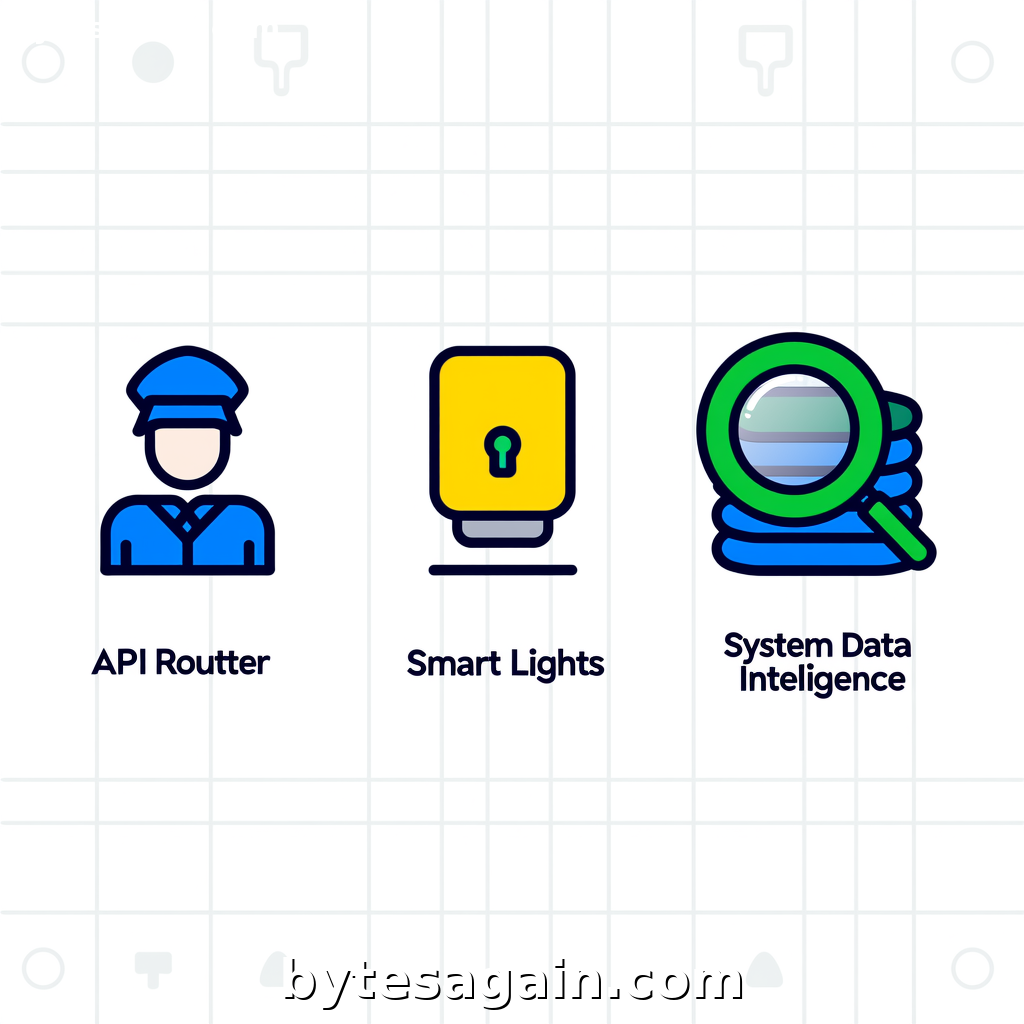
But a single skill rarely does it all. The use case bundles three distinct tools: API Router, Smart Lights, and a deep-data handler called system-data-intelligence-skill. Each one brings a different superpower to your support pipeline. Choosing the wrong one means slow escalations, missed context, or replies that sound robotic.
This article breaks down what each skill does, where it excels, and exactly when to use it. By the end, you'll know which AI agent to deploy for your specific support bottleneck.
The Three Skills at a Glance
API Router is a reference tool for developers. It gives your agent instant access to API Router concepts, quickstarts, and implementation patterns. Think of it as a living documentation browser that your AI can query mid-conversation. Its strength is speed: when a user asks "how do I set up webhooks?" or "what's the correct endpoint for authentication?", API Router finds the answer without you writing a single line of integration code.
Smart Lights is also a reference tool, but focused on IoT-style devices. It covers Smart Lights concepts — pairing, dimming, scheduling, and troubleshooting. If your support queue includes home automation questions, this skill answers them with the same quick-lookup efficiency. It's narrow but deep: it knows the common failure modes and best practices for connected lighting systems.
System Data Intelligence is a different beast. It's designed for direct operating system application control and in-depth data analysis. The skill activates when a user mentions reading or writing files (Excel, WPS, Word, TXT, Markdown, RTZ) or asks to extract data from any application. It also handles requests for trend analysis, anomaly detection, and prediction. This is your heavy lifter for data-heavy support scenarios.
Side-by-Side: Where Each Skill Shines
What They Do Best
- API Router excels at answering technical API questions instantly. It reduces time-to-resolution for developer-facing support tickets.
- Smart Lights is purpose-built for hardware troubleshooting. It handles configuration and error-recovery for smart lighting ecosystems.
- System Data Intelligence dominates file manipulation and data analysis. It can read a customer's uploaded spreadsheet, detect a pattern, and draft a contextual reply with the findings.
When to Use Each
- Use API Router when your support involves REST endpoints, SDKs, or integration guides. Example: a customer asks, "Why does my POST request return a 403?" The agent pulls the authentication pattern from API Router and explains the fix.
- Use Smart Lights when tickets mention device pairing, firmware updates, or lighting schedules. Example: "My bulbs won't sync after a power outage." The agent walks through the reset sequence using Smart Lights knowledge.
- Use System Data Intelligence when a customer attaches a file or describes a data problem. Example: "I exported my sales report from the CRM, but the numbers don't match last quarter." The agent opens the file, performs a trend analysis, and identifies the discrepancy.
Best Fit for User Types
- API Router fits technical support teams that serve developers, API partners, or internal engineering.
- Smart Lights fits consumer electronics support, home automation help desks, or IoT device manufacturers.
- System Data Intelligence fits enterprise support teams that handle data exports, compliance reports, or analytical queries from business users.
Real Scenario: The "Where's My Refund?" Ticket
Imagine a customer submits a support ticket: "I requested a refund three days ago. I attached my order confirmation and the cancellation email. Can you check the status and escalate if it's overdue?"
Here's how each skill would handle it:
API Router would try to find the refund API endpoint. It might respond with a template: "To check refund status, call GET /refunds/{id} with your order ID." But the customer didn't ask for an API call — they want action. This skill misses the mark.
Smart Lights would look for "refund" in its device documentation. It would find nothing relevant. The agent would fall back to a generic "I don't have that information" response. Not helpful.
System Data Intelligence would recognize the attached files (order confirmation and cancellation email), open them, extract the order ID and refund request date. It would then compare the current date to the SLA policy (e.g., refunds must be processed within 48 hours). If the deadline passed, it drafts a contextual reply: "Your refund request from June 10 is past the 48-hour SLA. I've escalated this to the billing team. Here's your case ID." It also writes the escalation note.
Winner: System Data Intelligence. It handles the file reading, the SLA calculation, and the escalation — exactly what the use case requires.
Actionable advice: For ticket routing and SLA breach detection, lean on System Data Intelligence. It's the only skill in this set that can open a file, calculate a deadline, and take action. Use API Router or Smart Lights only when your support queue is purely reference-based.
Recommendation: Which Skill for Which Support Team?
Choose API Router if your support team fields mostly "how do I integrate?" and "what's the correct parameter?" questions. It's a lightweight, fast lookup that keeps your agent from hallucinating API docs. Pair it with a general reasoning skill for best results.
Choose Smart Lights if your product is a connected device and customers need help with setup, connectivity, or troubleshooting. It's narrow but authoritative — customers get accurate device-specific answers without waiting for a human.
Choose System Data Intelligence if your support involves files, data analysis, or SLA enforcement. This is the skill that turns your AI agent from a chatbot into a proactive assistant that reads attachments, detects anomalies, and escalates automatically. It's the most versatile of the three for the Support Orchestrator use case.
For maximum coverage, combine System Data Intelligence with API Router. Let the data skill handle file-based tickets and SLA logic, while API Router catches technical integration questions. That two-skill setup covers 90% of support scenarios.
Final Verdict
The Support Orchestrator use case is built to reduce manual triage and speed up response times. But your choice of skill determines whether that agent is a helpful librarian or a proactive problem-solver. API Router and Smart Lights are excellent reference tools for narrow domains. System Data Intelligence is the only skill that actively manipulates data, reads files, and enforces business rules like SLA breaches.
If you're building a support agent that does more than answer questions — one that actually resolves tickets — start with System Data Intelligence and layer on API Router for technical depth. That combination gives you the file-crunching power and the API knowledge your customers expect.
Find more AI agent skills at BytesAgain.