

Published by BytesAgain · May 2026
Database Skills Showdown: Which AI Agent Skill Owns Your Data?
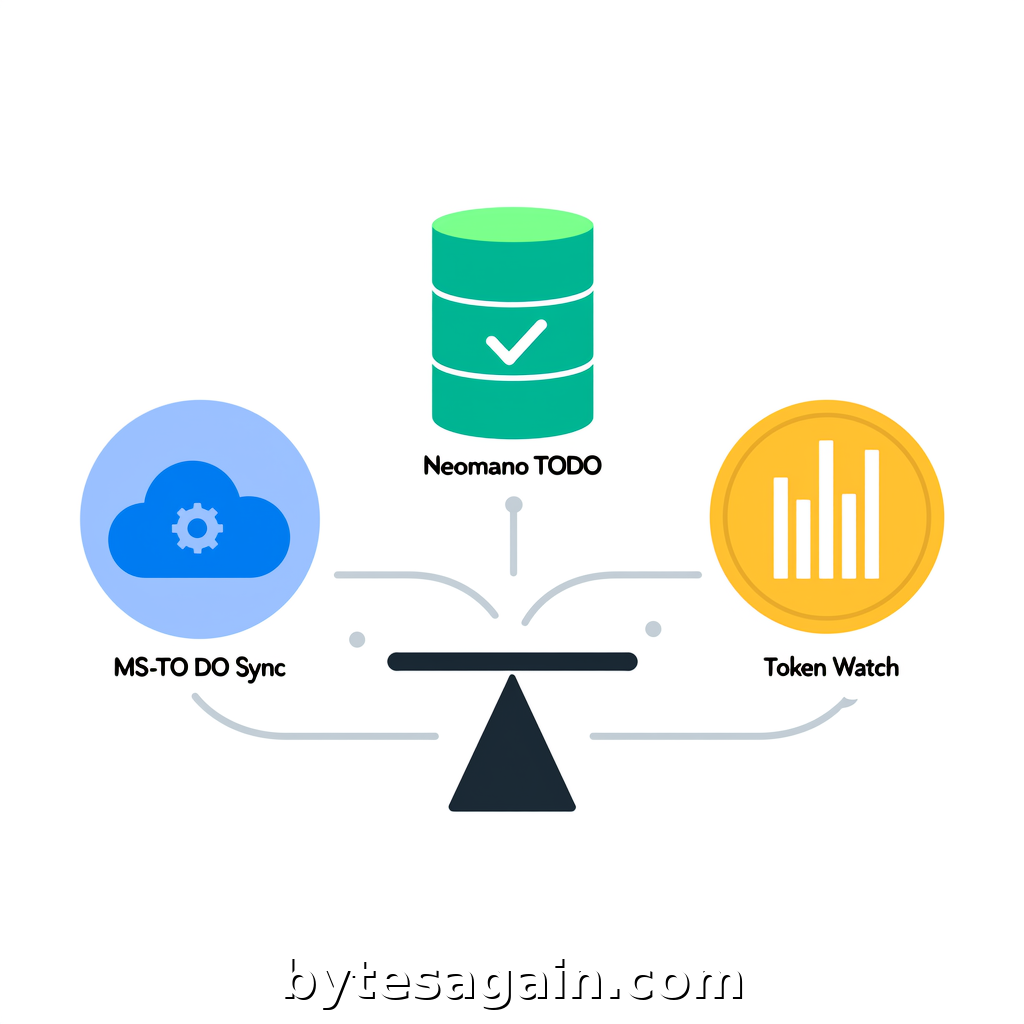
Every AI agent needs a memory. Without a reliable way to store, query, and sync data, your workflow collapses into a pile of forgotten tasks, duplicated entries, and lost context. The Database & Data Management use case at BytesAgain tackles this head-on, offering three distinct skills that each solve a critical piece of the data puzzle. Whether you want to automate task tracking with a cloud service, build a local relational database, or monitor the cost of your AI operations, there's an agent skill built for you.
This article compares three skills from the Database use case: ms-todo-sync, Neomano TODO, and Token Watch. We'll break down what each skill does, where it shines, and which one belongs in your agent's toolkit.
The Three Skills at a Glance
ms-todo-sync — Cloud Task Automation
ms-todo-sync is a CLI skill that connects your AI agent directly to Microsoft To Do via the Microsoft Graph API. It handles the full lifecycle of task management: listing, creating, completing, deleting, and searching tasks and lists. You can also view overdue items, today's tasks, pending work, and export data for analysis. Its strength lies in cloud-native synchronization—if your team relies on Microsoft 365, this skill keeps everyone aligned without manual updates.
Neomano TODO — Local SQLite Power
neomano-todo takes a different approach. Instead of relying on a cloud service, it stores tasks in a local SQLite database. This means no API limits, no internet dependency, and full control over your data. It supports priorities (1-3), tags, due dates, and reminder timestamps. For users who want a structured, relational foundation for their task data—beyond fragile flat files—this skill delivers reliability and queryability right on your machine.
Token Watch — Cost Intelligence
token-watch shifts focus from task management to operational awareness. It tracks and analyzes token usage and costs across AI providers. You get budget alerts, model cost comparisons, and optimization tips—all stored locally. This skill is essential for anyone running AI agents at scale, where runaway token consumption can silently drain resources.
Side-by-Side Comparison
Core Functionality
- ms-todo-sync focuses on cloud synchronization and multi-user task management via Microsoft Graph API.
- neomano-todo prioritizes local, offline-first storage with relational database querying.
- token-watch specializes in cost monitoring and budget control for AI API usage.
Data Storage
- ms-todo-sync stores data in Microsoft's cloud, accessible from any device with authentication.
- neomano-todo uses a local SQLite database—no external servers, no sync delays.
- token-watch stores usage data locally, keeping sensitive cost information private.
Best Use Cases
- ms-todo-sync is ideal for teams using Microsoft 365 who need shared task lists and real-time updates.
- neomano-todo fits individual users or small teams who want a robust, queryable task database without cloud dependency.
- token-watch is a must for developers, power users, or businesses managing multiple AI provider accounts.
Data Portability
- ms-todo-sync offers export functionality, but your primary data lives in Microsoft's ecosystem.
- neomano-todo gives you full database files—easy to backup, transfer, or query with SQL.
- token-watch keeps everything local, exportable as needed.
Real-World Scenario: Maria's AI Workflow
Maria runs a small AI consultancy. She uses multiple AI models (GPT-4, Claude, Gemini) for client projects and needs to manage tasks across her team.
The Problem: Maria's tasks are scattered across sticky notes, Slack messages, and a shared spreadsheet. She also worries about her monthly AI API costs spiraling out of control.
How She Uses These Skills:
Maria installs neomano-todo as her primary task manager. She creates a local SQLite database with priorities, tags, and due dates for each client project. When she's offline during travel, she still accesses and updates her tasks instantly.
For team collaboration, Maria adds ms-todo-sync. She links her Microsoft To Do account and syncs high-priority tasks from her local database to shared lists. Her team sees updates in real time without needing to install anything.
Finally, Maria installs token-watch to monitor her API consumption. It alerts her when a client project approaches its budget limit and suggests cheaper model alternatives for non-critical tasks.
The Result: Maria's workflow is now organized, synchronized, and cost-aware. Each skill handles a distinct layer of her data management stack.
Actionable Advice: Don't try to force one skill to do everything. Use neomano-todo for your local, private task database; ms-todo-sync for team collaboration; and token-watch to keep AI costs under control. They complement each other better than any single tool.
Which Skill for Which User?
For the Solo Developer
Choose neomano-todo if you want a fast, local, and queryable task database. You don't need cloud sync, and you value data ownership. Pair it with token-watch if you're experimenting with multiple AI models and want to track costs.
For the Team Lead
Start with ms-todo-sync. Your team already uses Microsoft 365? This skill integrates naturally. Add neomano-todo for your personal task management layer—keep private notes locally while sharing team tasks in the cloud.
For the AI Power User
token-watch is non-negotiable. Without it, you're flying blind on costs. Supplement with neomano-todo to build a structured database of prompts, outputs, and evaluations tied to specific models.
For the Enterprise Admin
Combine all three. Use ms-todo-sync for organization-wide task management, neomano-todo for departmental databases, and token-watch for cross-provider cost governance.
Final Recommendation
There is no single "best" skill here—each solves a different facet of database management. If you need cloud-native task sync, go with ms-todo-sync. If you want a local, relational task manager, neomano-todo is your pick. If you need to control AI spending, token-watch is essential.
For a complete data management strategy, consider using all three together. They share no dependencies, so you can install them side by side without conflicts. Start with the skill that solves your most urgent problem, then expand.
Find more AI agent skills at BytesAgain.