

Published by BytesAgain · May 2026
GDPR Compliance Toolkit: Which AI Skill Closes Your Data Protection Gap?
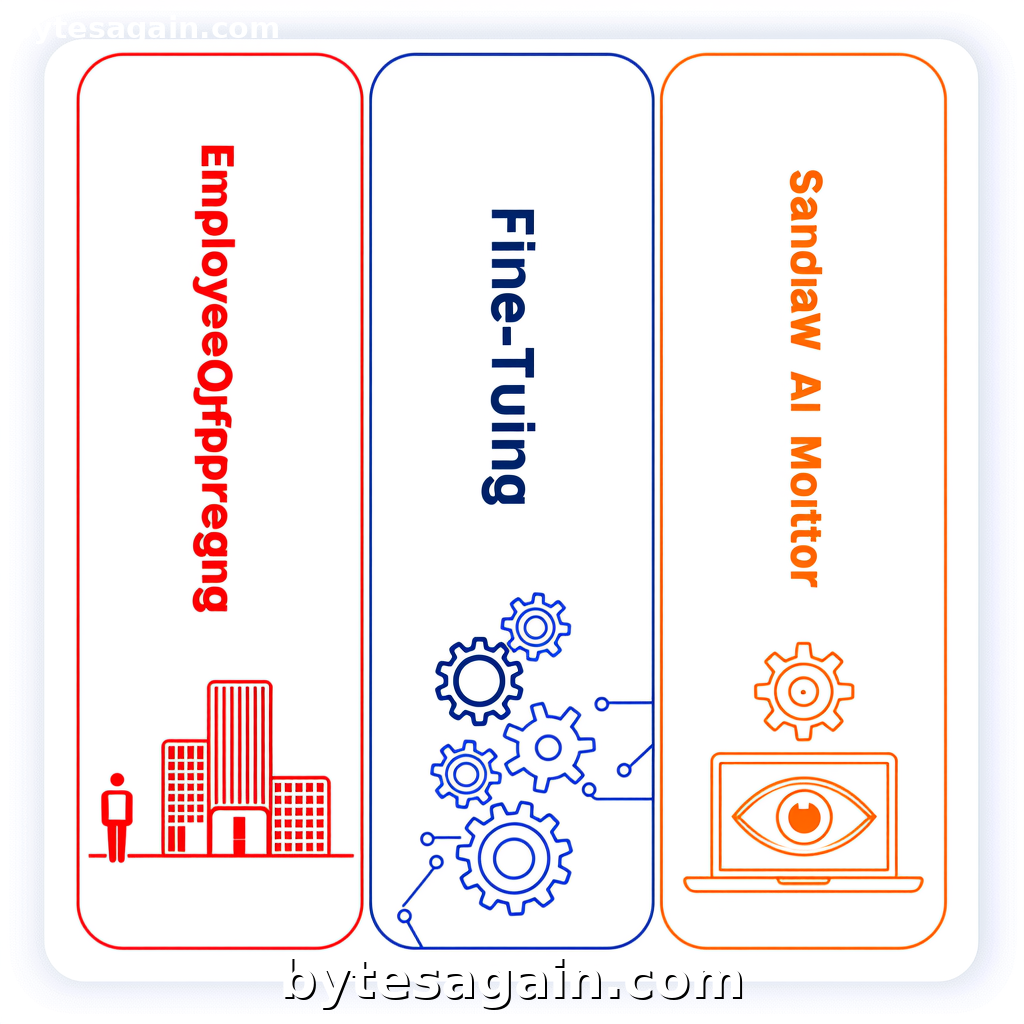
When a marketing manager installs an unapproved AI writing tool that ingests customer PII, or an offboarding process misses a data deletion deadline by three weeks, your organization faces real regulatory risk. GDPR compliance is not a one-time audit—it is a continuous operational challenge spanning data flows, third-party AI tool usage, and employee lifecycle events. The GDPR Compliance use case on BytesAgain tackles this by combining three distinct AI agent skills, each designed to automate a specific compliance gap. But which skill should you deploy first? And when should you combine them? This article compares Employee Offboarding Manager, Fine-Tuning, and Shadow AI Monitor side by side, so you can match the right agent to your biggest risk.
The Three Skills at a Glance
Employee Offboarding Manager focuses on the human lifecycle. It generates detailed offboarding checklists, knowledge transfer plans, compliance steps, manager transition documents, and day-by-day timelines for departing employees. Its strength lies in enforcing right-to-erasure workflows and access revocation automatically, ensuring no data deletion step is missed when someone leaves the organization.
Fine-Tuning addresses the model training pipeline. It handles data preparation, provider selection, cost estimation, evaluation, and compliance checks for custom LLMs. This skill ensures that any fine-tuned model is trained only on GDPR-sanitized datasets with documented lawful basis and purpose limitation, directly supporting Article 5 (data minimization) requirements.
Shadow AI Monitor provides enterprise-grade visibility into employee AI tool usage. It tracks which tools employees are using, identifies data exposure risks, and generates professional HTML dashboards for compliance reporting. This skill directly addresses Article 32 (security of processing) and helps organizations detect unauthorized AI tools that might expose personal data.
Side-by-Side Comparison
What Each Skill Automates
Employee Offboarding Manager automates the termination workflow: access revocation, data deletion triggers, manager notifications, and compliance checklists. It turns a manual, error-prone process into a repeatable, auditable sequence.
Fine-Tuning automates the data preparation and compliance validation layer for custom models. It checks datasets for PII, verifies lawful basis documentation, and ensures purpose limitation is baked into the training pipeline before a single epoch runs.
Shadow AI Monitor automates detection and visibility. It continuously scans for shadow AI usage, categorizes risk levels, and produces compliance-ready reports without requiring manual surveys or endpoint agents.
Best-Fit Scenarios
Employee Offboarding Manager is best when your organization has high employee turnover, contractors with temporary access, or roles that handle sensitive personal data. If your current offboarding process relies on a manager remembering to email IT, this skill closes that gap.
Fine-Tuning is best when your team builds custom LLMs for customer-facing applications, internal knowledge bases, or data analysis tools. If you are training models on datasets that contain personal information, this skill ensures you do not violate Article 5 data minimization or Article 15 right of access requirements.
Shadow AI Monitor is best when you suspect (or know) that employees are using unauthorized AI tools for work. If your organization has no visibility into which SaaS AI tools are processing customer data, this skill provides the dashboard and alerting needed for Article 32 compliance.
Overlap and Combinations
These skills are not mutually exclusive. In fact, they complement each other:
Shadow AI Monitor identifies a risky tool → Employee Offboarding Manager ensures that if the employee who introduced it leaves, their data and access are cleaned up.
Fine-Tuning creates a sanitized model → Shadow AI Monitor checks that no employee is using an external, non-sanctioned version of that model.
Employee Offboarding Manager triggers data deletion → Fine-Tuning ensures the deletion extends to any training datasets or model checkpoints that contained the former employee's data.
Real-World User Scenario
Consider a mid-sized fintech company with 200 employees, a growing custom LLM for customer support summarization, and a recent data subject access request that revealed an employee had been using an unapproved AI transcription tool containing client financial data.
Step 1: Deploy Shadow AI Monitor first. Within the first week, the compliance team discovers three unauthorized AI tools processing customer PII: a transcription service, a meeting note summarizer, and a code assistant that cached API keys. The dashboard generates a report for the DPO, and the team immediately blocks access to these tools.
Step 2: Run Employee Offboarding Manager for the departing contractor who introduced the transcription tool. The skill generates a 14-day offboarding plan with specific data deletion steps for the contractor's email, cloud storage, and any databases they accessed. The compliance checklist confirms that the right-to-erasure request from a former client (triggered by the data subject access request) is also handled within the same workflow.
Step 3: Apply Fine-Tuning to the customer support LLM. Before retraining the model on new data, the skill scans the training corpus for any residual PII from the contractor's period of employment. It verifies that the lawful basis for processing is documented and that the purpose limitation is explicitly stated in the model card. The result is a compliant, auditable model that can be deployed without regulatory risk.
Actionable advice: Start with Shadow AI Monitor if you have zero visibility into tool usage. Start with Employee Offboarding Manager if your turnover rate exceeds 15% annually. Start with Fine-Tuning only after you have verified that your training data pipeline is the primary compliance gap.
Which Skill for Which User Type
Compliance Officers and DPOs should prioritize Shadow AI Monitor and Employee Offboarding Manager. These two skills cover the most common GDPR audit findings: unauthorized data processing and incomplete deletion upon termination. The dashboard from Shadow AI Monitor provides evidence for Article 32 compliance, while the checklists from Employee Offboarding Manager document Article 17 (right to erasure) workflows.
Data Engineering and ML Teams should prioritize Fine-Tuning. If you are responsible for building and deploying custom models, this skill is your safeguard against training on non-compliant data. It also reduces the risk of downstream data subject access requests that require model explainability.
IT and Security Teams should prioritize Shadow AI Monitor first, then Employee Offboarding Manager. The detection capability gives you immediate risk reduction, while the offboarding automation ensures that when access is revoked, it is done completely and documented.
Small Business Owners managing GDPR compliance without a dedicated team should consider the full toolkit. Start with Employee Offboarding Manager for the highest-risk human processes, then add Shadow AI Monitor as the business grows and tool usage becomes harder to track manually. Fine-Tuning becomes relevant only if you begin training custom models.
Making the Choice
There is no single "best" skill for GDPR compliance—the right choice depends on where your organization's risk is concentrated. If you are losing sleep over unknown AI tool usage, choose Shadow AI Monitor. If offboarding is a manual mess with missed deletion deadlines, choose Employee Offboarding Manager. If you are building custom LLMs on customer data, choose Fine-Tuning.
The most resilient GDPR compliance program uses all three in concert, but you do not need to deploy them simultaneously. Start with the skill that addresses your most urgent gap, then layer in the others as your compliance maturity grows.
Explore the GDPR Compliance use case to see how these skills work together, or visit each skill page to evaluate which one fits your current workflow.
Find more AI agent skills at BytesAgain.